
Research Report
Warehouse Management System Market Overview & Dynamics
A warehouse management system (WMS) is a software solution designed to improve, automate, and assist a company’s warehouse operations and processes. This sort of software aids in the automated processing of order fulfilment operations, from the handling of raw materials through the transportation of finished items, in an organization’s supply chain management.
To get more Insights: Request Free Sample Report
E-Commerce Industry’s Accelerated Growth:
Because of the growing number of online shoppers, the e-commerce business is predicted to grow rapidly. Consumers have turned to internet purchasing as a result of the implementation of social distancing, lockdowns, and other measures in response to the COVID-19 epidemic. Customers also love buying from the comfort of their own homes and having their packages delivered to their doorsteps. Customers like things delivered to their address without spending time, hence home delivery has grown in popularity throughout the COVID-19 period.
In the e-commerce and online shopping industry, WMS enables businesses to quickly adjust to changing client demands. Furthermore, implementing a warehouse management system (WMS) aids in the optimal management of warehouses, resulting in higher warehouse productivity and efficiency, as well as shorter product delivery times.
- Relationships With Suppliers And Customers Have Improved:
While processing orders, WMS reduces delivery lead times and faults. While implementing WMS, suppliers want greater efficiency and productivity, which strengthens supplier–customer relationships and is a significant driver for the warehouse management system market globally.
- Digital Technology Adoption in Supply Chain Management:
The supply chain’s digitization will bring a number of other benefits, such as streamlined operations. Because procedures are automated and decision-making is robust and improved, digitization saves time. The errors are easily discovered and corrected. Collaboration and information exchange between vendors and companies are anticipated to be considerably more open in digital systems, resulting in increased productivity. The supply chain’s digitisation will also minimise lead times, increasing profitability.
Warehouse Management System Market Segmentation:
The report study will provide an accurate forecast of the main segments’ contribution to the warehouse management system market’s growth.
Rapid Growth of the Software of WMS to Propel Market Growth:
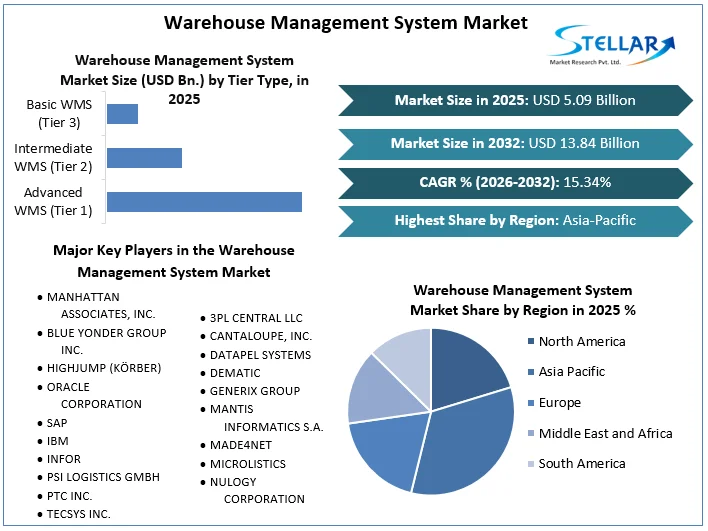
Based on Offering, software segment held the largest market share of 4.51 in 2024 and is projected to grow at the highest CAGR of 16.38% to reach US$ 15.17 Bn. by 2032. The expansion of the WMS software market is being driven by companies that are inventing services and functionality to improve user experience and operational effectiveness.
Cloud Is Expected To Account For The Largest 68% Market Share By 2032.
By deployment, Cloud segment was valued US$ 4.43 Bn. in 2024 and is expected to reach at US$ 13.87 Bn. by 2032 at a CAGR of 15.34% over forecast period. Companies are becoming more aware of cloud software’s benefits, such as cost savings and increased efficiency. The cloud system’s high adaptability is enticing even small businesses to invest less money in order to make a presence in the global warehouse management system industry. As a result, the increased adoption of cloud software systems by SMEs is having a favourable impact on the growth of the WMS industry.
Globally, Basic WMS (Tier 3) Segment Is Estimated To Grow At The Highest Rate, By Phase.
Tier 3 provides users with minimal WMS capabilities that allows them to manage material flow in manual warehouses and on conveyors. These can be combined into choosing systems and enterprise resource planning systems. They will run on home computers and will make use of mainstream operating systems such as Microsoft Windows. Growing application sectors around the world, such as healthcare, manufacturing, and retail, are likely to drive up need for basic warehouse management systems (WMS) to meet increased client demand.
Asia-Pacific to Retain Lead through 2032
Geographically, Because of its high-growth economies, such as China, India, and the Philippines, Asia-Pacific is expected to develop at the fastest rate of XX percent from 2026 to 2032. Consumer spending power is expanding in emerging countries, resulting in an increase in demand for end-use products. This has a favorable impact on WMS demand for a continuous supply of items. Furthermore, because Asia Pacific is a price-sensitive area, enterprises that use WMS technology choose SaaS. The model’s advantages, such as lower entry cost and risk, cost-effective expansion, access to the greatest technology, and dynamic and advanced software capabilities, are capturing the attention of manufacturers.
Strategic Expansion:
In recent years, major players in the Warehouse Management System Market have taken several strategic measures, such as facility expansions and partnerships.
- In April 2020, Softeon Company showcased their warehouse management and execution system capabilities at MODEX 2020, which was hosted in Atlanta. The company hopes to expand its consumer base in the global market as a result of their participation.
- In May 2020, Manhattan Associates has released the Manhattan Active warehouse management solution, a cloud-based enterprise-level warehouse management system that integrates all aspects of distribution and requires no upgrades. The Manhattan Active WMS is available as a multi-year cloud subscription and may be controlled from a mobile phone, tablet, or computer.
The objective of the report is to present a comprehensive analysis of the Warehouse Management System Market to the stakeholders in the industry. The report provides trends that are most dominant in the Warehouse Management System Market and how these trends will influence new business investments and market development throughout the forecast period. The report also aids in the comprehension of the Warehouse Management System Market dynamics and competitive structure of the market by analyzing market leaders, market followers, and regional players.
The qualitative and quantitative data provided in the Warehouse Management System Market report is to help understand which market segments, regions are expected to grow at higher rates, factors affecting the market, and key opportunity areas, which will drive the industry and market growth through the forecast period. The report also includes the competitive landscape of key players in the industry along with their recent developments in the Warehouse Management System Market. The report studies factors such as company size, market share, market growth, revenue, production volume, and profits of the key players in the Warehouse Management System Market.
The report provides Porter’s Five Force Model, which helps in designing the business strategies in the market. The report helps in identifying how many rivals are existing, who they are, and how their product quality is in the Market. The report also analyses if the Warehouse Management System Market is easy for a new player to gain a foothold in the market, do they enter or exit the market regularly if the market is dominated by a few players, etc.
The report also includes a PESTEL Analysis, which aids in the development of company strategies. Political variables help in figuring out how much a government can influence the Market. Economic variables aid in the analysis of economic performance drivers that have an impact on the Market. Understanding the impact of the surrounding environment and the influence of environmental concerns on the Warehouse Management System Market is aided by legal factors.